
La Bibliothèque d'Applications présente des modèles construits avec COMSOL Multiphysics pour la simulation d'une grande variété d'applications, dans les domaines de l'électromagnétisme, de la mécanique des solides, de la mécanique des fluides et de la chimie. Vous pouvez télécharger ces modèles résolus avec leur documentation détaillée, comprenant les instructions de construction pas-à-pas, et vous en servir comme point de départ de votre travail de simulation. Utilisez l'outil de recherche rapide pour trouver les modèles et applications correspondant à votre domaine d'intérêt. Notez que de nombreux exemples présentés ici sont également accessibles via la Bibliothèques d'Applications intégrée au logiciel COMSOL Multiphysics® et disponible à partir du menu Fichier.

Users of consumer electronics with radiating devices are exposed to radio frequency (RF) emission. The amount of exposure is defined as the specific absorption rate (SAR). That is, the SAR value represents the radio frequency (RF) energy rate absorbed by a body. This model computes local ... En savoir plus

This example shows how to set up multiple sandwiched thin layers with different thermal conductivities in two different ways. First, the composite is modeled as a 3D object. In the second approach the Thin Layer boundary condition with the thermally thick option is used to avoid ... En savoir plus

This example shows how to perform parameter optimization on a lens system. The optimization is motivated by the replacement of one of the glasses in a prior optical prescription with a new glass having slightly different optical dispersion coefficients. The control parameters are the ... En savoir plus

This tutorial models the cathodic protection of an oil rig structure during a time period of 15 years. As a result of the consumption of the sacrificial anodes, the protective capabilities system are reduced over time. The anode shape change in the model is defined by using the Level ... En savoir plus

This model example simulates an air-cooled cylindrical 18650 lithium-ion battery during a charge-discharge cycle, followed by a relaxing period. A lumped (0D) cell model is used to model the battery cell chemistry, and a two-dimensional axi-symmetrical model is used to model the ... En savoir plus
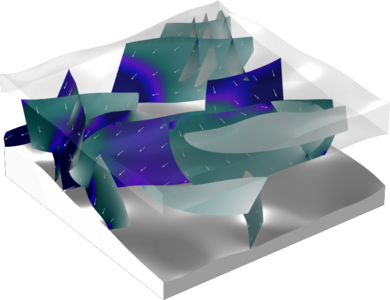
This model shows how to set up a simulation of flow through a fractured reservoir. The reservoir includes a discrete fracture network (DFN), where the fractures have a randomized distribution of position, size, orientation and aperture. The model uses the Discrete Fracture Network Add ... En savoir plus

This example models an oil reservoir with two horizontal wells. The reservoir contains two phases, water and oil. Oil is recovered by injecting water through the bottom well, so the oil production rate and the water-oil production ratio over time are computed. En savoir plus

This 2D example of a vanadium flow battery demonstrates how to couple a secondary current distribution model for an ion-exchange membrane to tertiary current distribution models for two different free electrolyte compartments of a flow battery. The Ion-Exchange Membrane boundary node ... En savoir plus
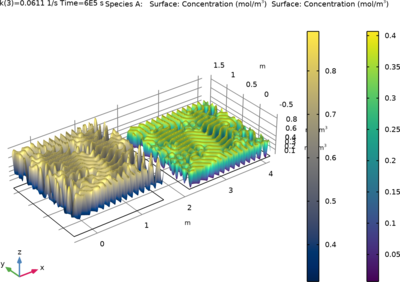
A deceptively simple system of two species and two reactions, describing the autocatalytic conversion of a substance, is shown to display a surprisingly exotic behavior. Starting from a 0D CSTR description, a 2D reaction-diffusion problem is formulated showing rich patterns stemming from ... En savoir plus

This tutorial model uses a heat sink geometry from the Part Library. The tutorial shows different approaches to heat transfer modeling when studying the cooling of an electronic chip. In the first part, only the solid parts are modeled, while the convective airflow is modeled using ... En savoir plus


