
La Bibliothèque d'Applications présente des modèles construits avec COMSOL Multiphysics pour la simulation d'une grande variété d'applications, dans les domaines de l'électromagnétisme, de la mécanique des solides, de la mécanique des fluides et de la chimie. Vous pouvez télécharger ces modèles résolus avec leur documentation détaillée, comprenant les instructions de construction pas-à-pas, et vous en servir comme point de départ de votre travail de simulation. Utilisez l'outil de recherche rapide pour trouver les modèles et applications correspondant à votre domaine d'intérêt. Notez que de nombreux exemples présentés ici sont également accessibles via la Bibliothèques d'Applications intégrée au logiciel COMSOL Multiphysics® et disponible à partir du menu Fichier.
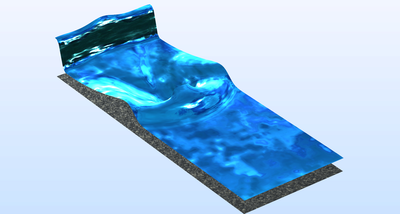
This example uses the Shallow Water equations to model the impact of a water wave on a column. A body of water with a height of 0.3 meters is initially contained behind a gate. At the start of the simulation, the gate is suddenly released and the body of water forms a wave moving toward ... En savoir plus

Ion-exchange is a powerful method to separate proteins from solutions and is today readily used in biotechnological and pharmaceutical industry. This model simulates an ion-exchange column for protein adsorption. The fluid phase contains four components: two proteins, solvent, and one ... En savoir plus
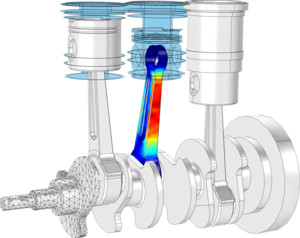
In this example, a dynamic analysis of a three-cylinder reciprocating engine is performed to investigate stresses generated during operation, thereby permitting identification of the critical components. Demand for high power output relative to the weight of the engine requires careful ... En savoir plus
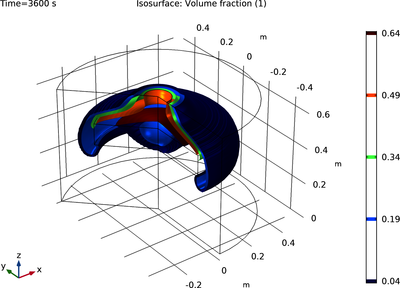
This example demonstrate two-phase flow in a porous medium which contains a low permeable lens. The heavier phase infiltrates the porous medium, so the low permeable lens is infiltrated only when a critical saturation at the outside is reached. En savoir plus

This model demonstrates the Lithium-Ion Battery interface for studying the discharge and charge of a lithium-ion battery for a given set of material properties. The geometry is in one dimension and the model is isothermal. Battery developers can use the model to investigate the influence ... En savoir plus

This model example simulates an air-cooled cylindrical 18650 lithium-ion battery during a charge-discharge cycle, followed by a relaxing period. A lumped (0D) cell model is used to model the battery cell chemistry, and a two-dimensional axi-symmetrical model is used to model the ... En savoir plus

A paraboloidal dish can concentrate solar energy onto a target (receiver), resulting in very high local heat fluxes. This can be used to generate steam, which can be used to power a generator, or hydrogen, which can be used directly as a fuel source. In this model, the heat flux arriving ... En savoir plus

This tutorial series demonstrates how to import printed circuit board (PCB) data from the IPC-2581 file format and generate simulation-ready geometry. Key topics include selecting the import type, handling drill layers, creating simplified 3D components and pads, and previewing file ... En savoir plus
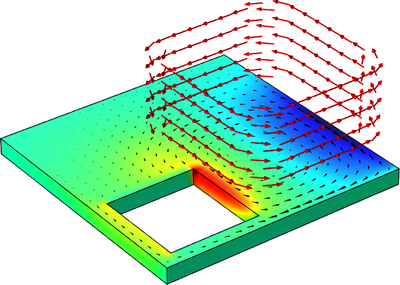
This model solves the Testing Electromagnetic Analysis Methods (TEAM) problem 7, “Asymmetrical Conductor with a Hole”—a benchmark problem concerning the calculation of eddy currents and magnetic fields produced when an aluminum conductor is placed asymmetrically above a multi-turn coil ... En savoir plus

This is a tutorial model that illustrates the use of the scattered field formulation in acoustics. A solid object (here an ellipsoid) is hit by an incident plane wave field (background pressure field). The model solves for the scattered field. The model uses a PML and a far-field ... En savoir plus


