
La Bibliothèque d'Applications présente des modèles construits avec COMSOL Multiphysics pour la simulation d'une grande variété d'applications, dans les domaines de l'électromagnétisme, de la mécanique des solides, de la mécanique des fluides et de la chimie. Vous pouvez télécharger ces modèles résolus avec leur documentation détaillée, comprenant les instructions de construction pas-à-pas, et vous en servir comme point de départ de votre travail de simulation. Utilisez l'outil de recherche rapide pour trouver les modèles et applications correspondant à votre domaine d'intérêt. Notez que de nombreux exemples présentés ici sont également accessibles via la Bibliothèques d'Applications intégrée au logiciel COMSOL Multiphysics® et disponible à partir du menu Fichier.
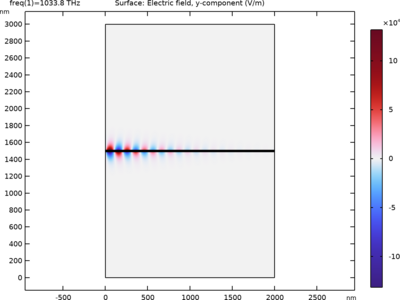
This model demonstrates how to simulate surface plasmon polaritons in a thin metal layer embedded in dielectric layers. It calculates the dispersion and propagation length of surface plasmon polaritons as a function of photon energy. En savoir plus
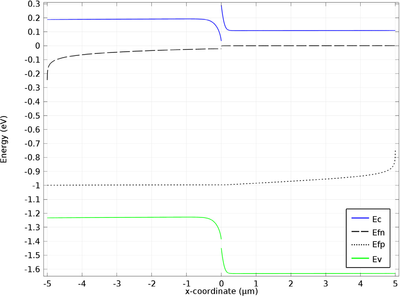
This benchmark model simulates three different heterojunction configurations under forward and reverse bias. It shows the difference in using the continuous quasi-Fermi level formulation versus the thermionic emission formulation for the charge transfer across the heterojunction. The ... En savoir plus
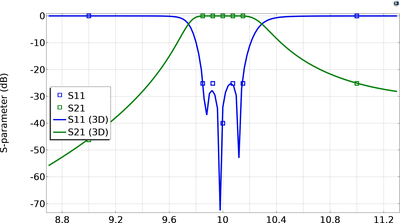
A waveguide filter is designed using shape optimization. The irises of the initial geometry are optimized to ensure good bandpass response and out-of-band rejection, while maintaining the double mirror symmetry. En savoir plus

This tutorial model demonstrates how to compute the impedance of a capacitively coupled plasma. The Time Periodic study computes the time periodic solution of the plasma. Subsequently, the solution is transformed to the time domain, after which the fast Fourier transform (FFT) solver is ... En savoir plus

Conical antennas are useful for many applications due to their broadband characteristics and relative simplicity. In this example, we study the antenna impedance and radiation pattern as functions of frequency for a monoconical antenna with a finite ground plane and a 50 ohm coaxial ... En savoir plus
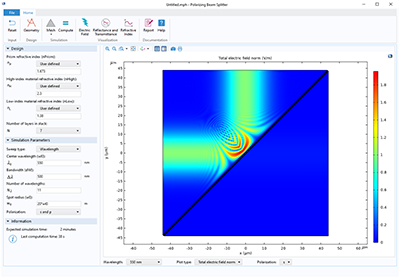
A Gaussian beam is incident on a 45-degree thin-film stack embedded in glass material prisms. The thin-film stack is designed from alternating high and low refractive index materials. The wave will be refracted at the Brewster angle at each internal interface. Thus, mainly p-polarized ... En savoir plus
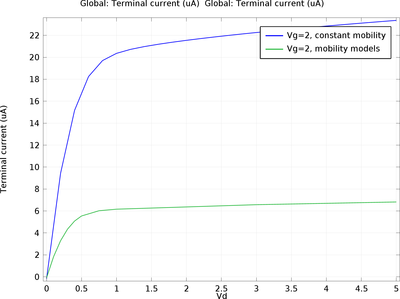
This model shows how to add several linked mobility models to the simple MOSFET example. En savoir plus
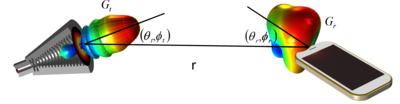
Multiscale modeling is a challenging issue in modern simulation. This occurs when there are vastly different scales in the same model. For example, your cell phone is approximately 10 cm, yet it receives GPS information from satellites 20,000 km away. In these models we examine several ... En savoir plus
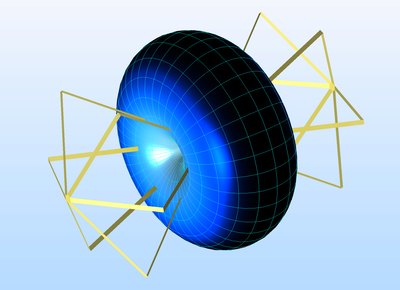
Biconical antennas are popular for very high frequency (VHF) measurement because they support a wide frequency range. They are also useful for electromagnetic compatibility (EMC) testing where the antenna can be used as an RF source in susceptibility or immunity test. This model ... En savoir plus
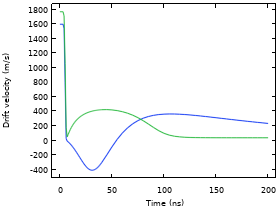
This tutorial model presents a study showing the transient negative mobility and the negative differential conductivity effects in xenon. The stationary and time dependent Boltzmann equation in the two-term approximation is used to compute the electron energy distribution function. ... En savoir plus


