
La Bibliothèque d'Applications présente des modèles construits avec COMSOL Multiphysics pour la simulation d'une grande variété d'applications, dans les domaines de l'électromagnétisme, de la mécanique des solides, de la mécanique des fluides et de la chimie. Vous pouvez télécharger ces modèles résolus avec leur documentation détaillée, comprenant les instructions de construction pas-à-pas, et vous en servir comme point de départ de votre travail de simulation. Utilisez l'outil de recherche rapide pour trouver les modèles et applications correspondant à votre domaine d'intérêt. Notez que de nombreux exemples présentés ici sont également accessibles via la Bibliothèques d'Applications intégrée au logiciel COMSOL Multiphysics® et disponible à partir du menu Fichier.
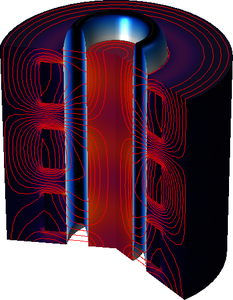
Induction pumps are used in high temperature cooling systems. The principle of operation is equivalent to a linear three phase induction motor. The lack of moving parts and the pumped liquid being kept in a hermetically closed system are clear advantages. This model shows how to simulate ... En savoir plus

Quantum dots are nano- or microscale devices created by confining free electrons in a 3D semiconducting matrix. Those tiny islands or droplets of confined “free electrons” (those with no potential energy) present many interesting electronic properties. They are of potential importance ... En savoir plus
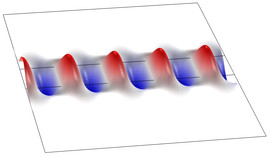
A planar dielectric slab waveguide demonstrates the principles behind any kind of dielectric waveguide such as a ridge waveguide or a step-index fiber. This model solves for the effective index and fields of a dielectric slab waveguide and compares the solution to analytic results. En savoir plus

This model shows how to use the Metal Processing Module and the Optimization Module to calibrate parameters of a phase transformation model against TTT (Time Temperature Transformation) data. En savoir plus

Zinc-Silver oxide (Zn-AgO) batteries are used in different industries due to their high capacity per unit weight. In this work, discharge of a Zn-AgO battery is simulated using the Battery with Binary Electrolyte interface. The electrochemical reactions in the positive and negative ... En savoir plus

This model simulates atmospheric galvanic corrosion of an aluminum alloy in contact with steel. The electrolyte film thickness depends on the relative humidity of the surrounding air and the salt load density of NaCl crystals on the metal surface. Empirical expressions for the oxygen ... En savoir plus
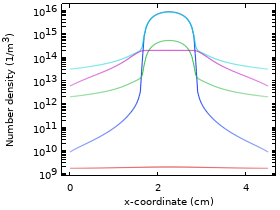
This tutorial model solves for a one-dimensional capacitively coupled plasma reactor in a mixture of argon/oxygen. Important aspects and strategies for modeling electronegative discharges are discussed. En savoir plus

In this example, the transient response of a shallow foundation resting on an unsaturated soil stratum is investigated. The changes in pore suction due to water infiltration and evaporation are analyzed using the Extended Barcelona Basic soil model. The results show how the deformation ... En savoir plus

A surface acoustic wave (SAW) is an acoustic wave propagating along the surface of a solid material. Its amplitude decays rapidly, often exponentially, through the depth of the material. SAWs are utilized in many kinds of electronic components, including filters, oscillators, and ... En savoir plus
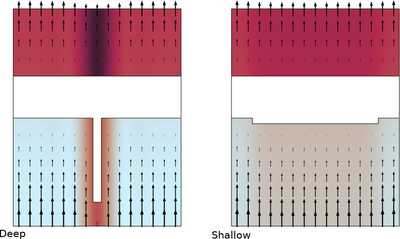
The copper current collector on negative graphite electrodes in lithium-ion batteries have been seen to dissolve at over discharge. This can be a safety concern as the dissolution damages the current collector irreversibly and dissolved copper ions can redeposit and form dendrites. ... En savoir plus


