
La Bibliothèque d'Applications présente des modèles construits avec COMSOL Multiphysics pour la simulation d'une grande variété d'applications, dans les domaines de l'électromagnétisme, de la mécanique des solides, de la mécanique des fluides et de la chimie. Vous pouvez télécharger ces modèles résolus avec leur documentation détaillée, comprenant les instructions de construction pas-à-pas, et vous en servir comme point de départ de votre travail de simulation. Utilisez l'outil de recherche rapide pour trouver les modèles et applications correspondant à votre domaine d'intérêt. Notez que de nombreux exemples présentés ici sont également accessibles via la Bibliothèques d'Applications intégrée au logiciel COMSOL Multiphysics® et disponible à partir du menu Fichier.

This model calculates the eigenfrequencies and mode shapes of an unconstrained cylinder in axisymmetry. The model is taken from NAFEMS Free Vibration Benchmarks. The eigenfrequencies are compared with the values given in the benchmark report. Three different physics interfaces are ... En savoir plus

In this model, the effect of corrosion product on galvanic corrosion between a magnesium alloy (AE44) and mild steel in contact with brine solution is presented, wherein deformed boundaries due to both deposition of corrosion product as well as dissolution of magnesium are considered. ... En savoir plus
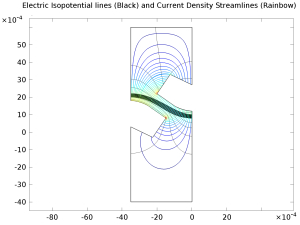
The chlor-alkali membrane process is one of the largest in industrial electrolysis with the production of roughly 40 million metric tons of both chlorine and caustic soda per year. Chlorine is used predominantly for the production of vinyl chloride monomer, which in turn is used for the ... En savoir plus
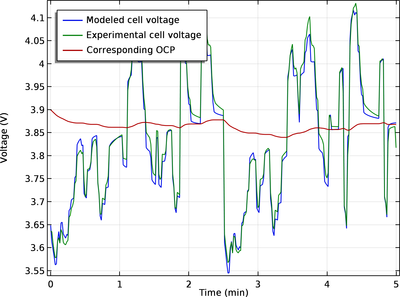
This tutorial uses a “black-box” approach to define a battery model based on a small set of lumped parameters, assuming no knowledge of the internal structure or design of the battery electrodes, or choice of materials. The input to the model is the battery capacity, the initial state ... En savoir plus
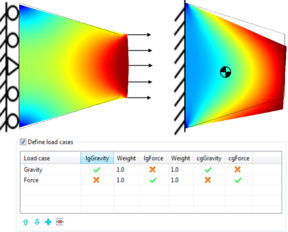
This example shows a 2D plane stress model of a thin tapered cantilever. Different boundary and load scenarios are examined. It is demonstrated how to apply and how to evaluate different load and constraint groups. Resulting stresses are compared to NAFEMS benchmark values and they are ... En savoir plus
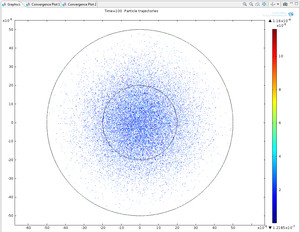
Transport which is purely diffusive in nature can be modeled using a Brownian force. This model shows how to add such a force in the Particle Tracing for Fluid Flow physics interface. Particle diffusion in a fluid is modeled with the diffusion equation and the Particle Tracing for Fluid ... En savoir plus
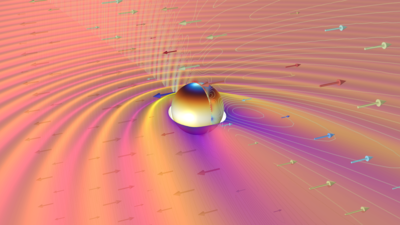
This model illustrates the process of evaluating the radar cross section (RCS) of a metallic sphere through the utilization of the boundary element method (BEM). By taking advantage of a vertical symmetry plane that is parallel to the polarization of an incident background field, the ... En savoir plus

This example shows how to set up self-contact for a coil spring. As the spring is compressed by a vertical force applied to one of its ends, it comes into to contact with itself and starts to rotate. En savoir plus
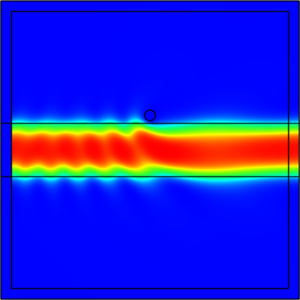
This model includes a dielectric slab waveguide with a small lossy metallic object nearby. The object causes light to be scattered, absorbed, and both reflected and transmitted along the waveguide. Learn more in this accompanying blog post: Modeling a Scatterer Near an Optical Waveguide En savoir plus

Non-Newtonian fluids have complex flow characteristics that vary with shear rate, making their behavior in porous materials difficult to predict. Pore scale modeling captures these flow patterns at a microscopic level, helping derive properties for macroscale use. This model ... En savoir plus


