
La Bibliothèque d'Applications présente des modèles construits avec COMSOL Multiphysics pour la simulation d'une grande variété d'applications, dans les domaines de l'électromagnétisme, de la mécanique des solides, de la mécanique des fluides et de la chimie. Vous pouvez télécharger ces modèles résolus avec leur documentation détaillée, comprenant les instructions de construction pas-à-pas, et vous en servir comme point de départ de votre travail de simulation. Utilisez l'outil de recherche rapide pour trouver les modèles et applications correspondant à votre domaine d'intérêt. Notez que de nombreux exemples présentés ici sont également accessibles via la Bibliothèques d'Applications intégrée au logiciel COMSOL Multiphysics® et disponible à partir du menu Fichier.

In this example, the eigenmodes of a structural damper are computed. In the damper, most of the deformation is controlled by the viscoelastic domains, which have strongly frequency-dependent stiffness and damping properties. This leads to a nonlinear eigenfrequency problem, which can be ... En savoir plus

In this tutorial the acoustic behavior of a duct or waveguide with a right angled bend is analyzed. The model uses port boundary conditions at the inlet and outlet. The ports can capture and treat non-plane propagating modes in waveguides, extending the analysis above the first cutoff ... En savoir plus
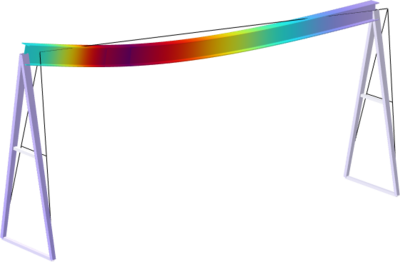
Portal Cranes are common when handling heavy loads. In this example, the Beam interface is used to compute the stresses in a portal crane designed for lifting 15 tons. Three load cases are considered: self weight, payload, and thermal expansion on a hot summer day. An internal hinge ... En savoir plus

This is a template base model containing the physics, geometry and mesh of a lithium-ion battery, defined in 1D. The model makes use of four lithiation parameters which are used to define the relative balancing of the negative and positive electrodes, as well as global cell state of ... En savoir plus
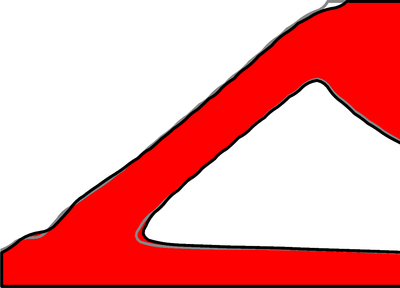
This model demonstrates how the Free Shape Boundary feature can be used to perform shape optimization on a design found with topology optimization. The model uses the same objective and constraint as the original, which results in a slightly higher stiffness for the same mass. En savoir plus
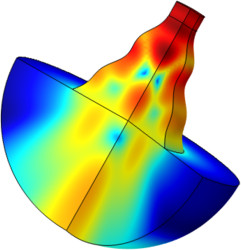
A plane-wave mode feeds an axisymmetric horn radiating from an infinite baffle toward an open half space. The radius of the waveguide attached to the horn throat is assumed to be fixed, as well as the depth of the horn and the size of the horn mouth attached to the baffle. By varying the ... En savoir plus
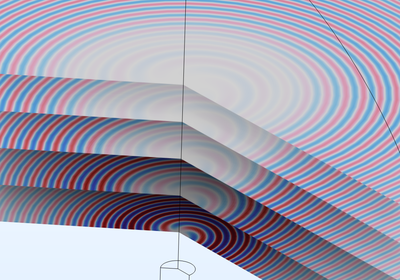
Model of the sound radiation from a circular duct with uniform flow. The convected acoustic problem is described using the linearized potential flow equations, solved in the frequency domain. The acoustic inlet is treated including higher order modes using the Port boundary condition and ... En savoir plus
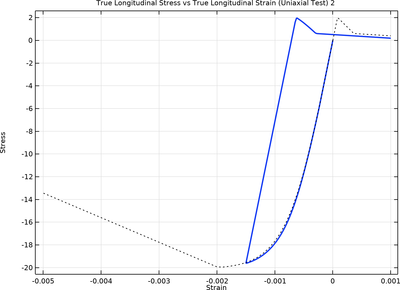
This example shows the behavior of the coupled damage-plasticity material model for concrete when subjected to different loading conditions. En savoir plus

This tutorial model presents a study of a double-headed streamer in nitrogen at atmospheric pressure. An initial seed of electrons is placed between two electrodes which apply an initial electric field of 52 kV/cm to the gas. A negative and positive streamer propagate toward the ... En savoir plus
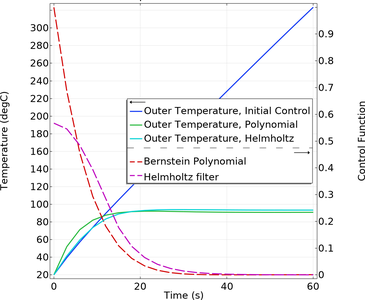
This is an example of optimal control, where the input heating power to a rod is optimized to give a certain temperature on the outside of the rod. This is where the maximum water temperature occurs, while the minimum occurs at the center. Therefore this problem corresponds to the ... En savoir plus


