
La Bibliothèque d'Applications présente des modèles construits avec COMSOL Multiphysics pour la simulation d'une grande variété d'applications, dans les domaines de l'électromagnétisme, de la mécanique des solides, de la mécanique des fluides et de la chimie. Vous pouvez télécharger ces modèles résolus avec leur documentation détaillée, comprenant les instructions de construction pas-à-pas, et vous en servir comme point de départ de votre travail de simulation. Utilisez l'outil de recherche rapide pour trouver les modèles et applications correspondant à votre domaine d'intérêt. Notez que de nombreux exemples présentés ici sont également accessibles via la Bibliothèques d'Applications intégrée au logiciel COMSOL Multiphysics® et disponible à partir du menu Fichier.

This tutorial demonstrates a full electro-vibroacoustic analysis of a conceptual electrostatic speaker driver, composed of thin conducting plastic diaphragm residing between two perforated metal sheets called grids or stators. When an audio signal is applied to the grids (out of phase), ... En savoir plus

The flash method is widely used for measuring the thermal conductivity of a thin sample material that is about the size of a coin. The sample material is submitted to a laser pulse on one of its faces. In turn, the opposite face is heated up by around 1 K. As the pulse is uniform and ... En savoir plus

This model shows that the frequency response, i.e., admittance curve, of the SAW unit cell with IDT is in good agreement with the series resonance & antiresonance frequencies obtained from the eigenfrequency studies in the tutorial Surface Acoustic Wave Velocity Calculations from a ... En savoir plus

This example exemplifies how to model thermal curing using the base package of COMSOL Multiphysics. A more detailed description of the phenomenon and the modeling process can be seen in the blog post "Modeling the Thermal Curing Process". En savoir plus
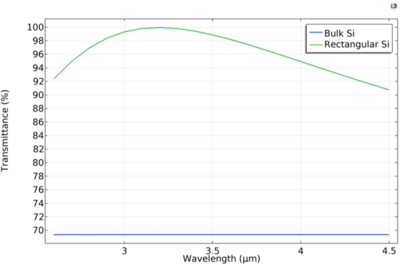
The design of antireflective coating plays an important role to increase the transmission of the infrared light that propagates through optical structures such as lens and windows. In this model, we showcase how different bulk structures such as Si and CZT that has the bulk ... En savoir plus

This model illustrates the working principle of a passive electrodynamic bearing. An electrically conducting rotor rotating in a magnetic field produced by a permanent magnets induces eddy currents on the conducting rotor. The eddy currents, in turn, produce a magnetic field that opposes ... En savoir plus

This model shows how to simulate the complex discharge physics behind the well-known electrostatic discharge (ESD). The model connects the Electrical Discharge interface with the Circuit interface to simulate how ESD current is generated when a human hand touches metal. En savoir plus

This model demonstrates the caustic effect produced by a cylindrical mirror. It highlights the advantages of the forward ray shooting method when modeling specular reflections from an external radiation source with the Surface-to-Surface Radiation interface. En savoir plus

This model computes the fundamental eigenfrequency and eigenmode for a tuning fork that is synchronized from SOLIDWORKS® via the LiveLink™ interface. The length of the fork is then optimized so that the tuning fork sounds the note A, 440 Hz. En savoir plus

This example exemplifies how to model the switching between current and voltage excitations in Terminal boundary conditions. A more detailed description of the phenomenon and the modeling process can be seen in the blog post "Control Current and Voltage Sources with the AC/DC Module". En savoir plus


