
La Bibliothèque d'Applications présente des modèles construits avec COMSOL Multiphysics pour la simulation d'une grande variété d'applications, dans les domaines de l'électromagnétisme, de la mécanique des solides, de la mécanique des fluides et de la chimie. Vous pouvez télécharger ces modèles résolus avec leur documentation détaillée, comprenant les instructions de construction pas-à-pas, et vous en servir comme point de départ de votre travail de simulation. Utilisez l'outil de recherche rapide pour trouver les modèles et applications correspondant à votre domaine d'intérêt. Notez que de nombreux exemples présentés ici sont également accessibles via la Bibliothèques d'Applications intégrée au logiciel COMSOL Multiphysics® et disponible à partir du menu Fichier.

In a MESFET, the gate forms a rectifying junction that controls the opening of the channel by varying the depletion width of the junction. In this model we simulate the response of a n-doped GaAs MESFET to different drain and gate voltages. For a n-doped material the electron ... En savoir plus
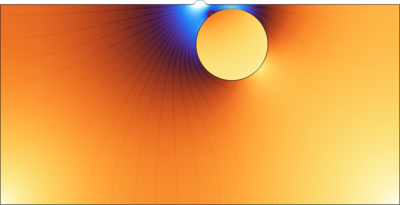
Electric impedance measurements are used for imaging and detection. Applications range from nondestructive testing and geophysical imaging to medical imaging. Several alternative techniques are shown to model such a system. One of them shows how to use conditional expressions to define ... En savoir plus

This model computes the fundamental eigenfrequency and eigenmode for a tuning fork that is synchronized from Inventor® via the LiveLink™ interface. The length of the fork is then optimized so that the tuning fork sounds the note A, 440 Hz. En savoir plus

This example simulates the temperature dynamics in cylindrical battery, initially at room temperature, after being placed in an oven. As the temperature increases, various exothermal decomposition reactions are activated, which in turn result in further heating of the battery. En savoir plus
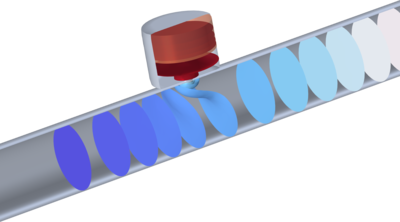
This tutorial model shows a system consisting of a Helmholtz resonator on the side of a main duct. The resonator volume is partly filled with a porous material. The model computes the reflection, transmission, and absorption of the system. Thermoviscous losses are included in the model ... En savoir plus

For models with acoustic-structure couplings it is necessary to calculate the left eigenvectors to use the Frequency Domain, Modal solver. The model shows the necessary changes to the default settings of the eigenfrequency solver. En savoir plus
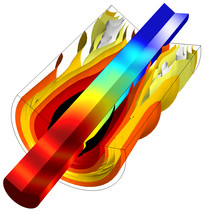
This model utilizes the thermoviscous acoustic interface in a sub-model to obtain detailed results for the transfer impedance of a perforated plate (including the thermal and viscous losses). The impedance is in turn used as an internal impedance in a pressure acoustic model of a ... En savoir plus

This model showcases the broadband optimization for the Microstructured antireflective coatings that are modeled in the model (#99011). Following are the parameters that are optimized: Rectangular microstructure: Height and width of the rectangular microstructure. Pyramidal ... En savoir plus

This document explains how to install and run COMSOL Multiphysics® and COMSOL Server™ with Microsoft® Azure. This requires that you have first acquired a Floating Network License (FNL) or COMSOL Server License (CSL) from COMSOL. The license manager software can run ... En savoir plus
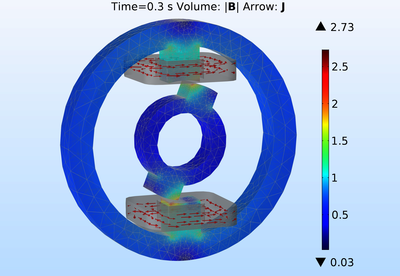
Switched reluctance motors work on the principle of reluctance torque. The stator and rotor will interact to minimize the reluctance for the flux path. This application simulates the behavior of the motor when the stator winding is excited with a step voltage and when the rotor is at a ... En savoir plus


