
La Bibliothèque d'Applications présente des modèles construits avec COMSOL Multiphysics pour la simulation d'une grande variété d'applications, dans les domaines de l'électromagnétisme, de la mécanique des solides, de la mécanique des fluides et de la chimie. Vous pouvez télécharger ces modèles résolus avec leur documentation détaillée, comprenant les instructions de construction pas-à-pas, et vous en servir comme point de départ de votre travail de simulation. Utilisez l'outil de recherche rapide pour trouver les modèles et applications correspondant à votre domaine d'intérêt. Notez que de nombreux exemples présentés ici sont également accessibles via la Bibliothèques d'Applications intégrée au logiciel COMSOL Multiphysics® et disponible à partir du menu Fichier.
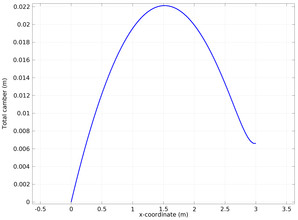
In this example you will build and solve a 3D beam model using the 3D Beam interface. This model shows how a thermally induced deformation of a beam is modeled. Temperature differences are applied across the top and bottom surfaces as well as the left and right surfaces of the beam. ... En savoir plus

This model simulates the propagation of a positive streamer in a weak electric field where the process of photoionization is essential to provide seed electrons at the front of the streamer head. The simulated electric field and electron density as a function of time agree well with that ... En savoir plus
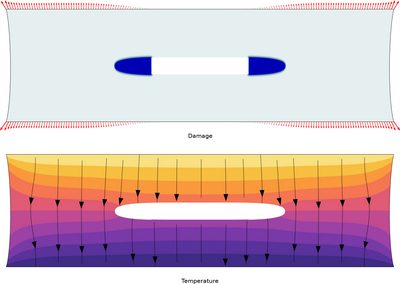
This model demonstrates how to set up a phase field damage multiphysics model to predict crack propagation in thermoelastic solids under large deformations. The crack-driving force depends on the principal stresses, which in turn depend on the temperature distribution in the solid ... En savoir plus
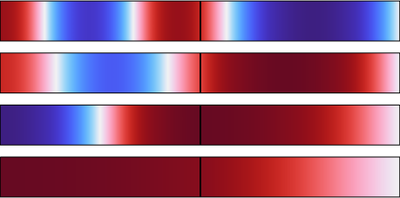
This tutorial demonstrates how to model the interaction between an acoustic field and the heat release from a flame, using the Flame Model domain feature. Modeling this interaction is important in order to understand and predict unstable acoustic modes in gas turbines and jet engines. ... En savoir plus

This tutorial model demonstrates the use of the multiphysics coupling feature Thermal Connection, Layered Shell, Edges. In this model, three layered shells are connected to heat domains by edges at difference locations related to the heat domains. The results obtained with the Heat ... En savoir plus

This tutorial illustrates the use of the connecting features in the Heat Transfer in Solids and Heat Transfer in Shells interfaces, to couple them to a Lumped Thermal System interface. The results obtained with the solid and shell models are compared. En savoir plus

This example models a small reverse osmosis water desalination unit. The unit consists of a spirally wound semi-permeable membrane through which the water is forced under high pressure. The membrane retains the salt, such that on the permeate side fresh water is produced and on the ... En savoir plus

This example exemplifies how to model thermal curing using the base package of COMSOL Multiphysics. A more detailed description of the phenomenon and the modeling process can be seen in the blog post "Modeling the Thermal Curing Process". En savoir plus

This example illustrates how to set up and solve a tank-in-series model in 0D using the Reaction Engineering interface. The model treats a series of three consecutive tank reactors. A feedback loop continuously adjusts the inlet concentration of the first tank to keep the concentration ... En savoir plus
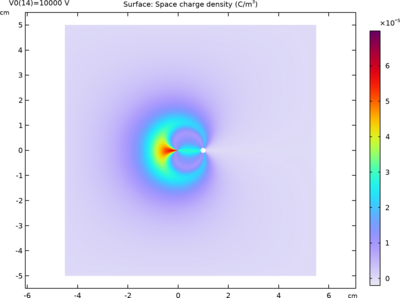
This model utilizes a continuation solver to efficiently compute the current–voltage characteristics of a corona discharge generated by a wire-to-wire configuration. It provides a flexible framework that can be easily adapted to study other discharge configurations and types. En savoir plus


