
La Bibliothèque d'Applications présente des modèles construits avec COMSOL Multiphysics pour la simulation d'une grande variété d'applications, dans les domaines de l'électromagnétisme, de la mécanique des solides, de la mécanique des fluides et de la chimie. Vous pouvez télécharger ces modèles résolus avec leur documentation détaillée, comprenant les instructions de construction pas-à-pas, et vous en servir comme point de départ de votre travail de simulation. Utilisez l'outil de recherche rapide pour trouver les modèles et applications correspondant à votre domaine d'intérêt. Notez que de nombreux exemples présentés ici sont également accessibles via la Bibliothèques d'Applications intégrée au logiciel COMSOL Multiphysics® et disponible à partir du menu Fichier.

This example demonstrates how to couple the Lithium-ion Battery interface to the Phase Field interface for modeling electrode deformations. The example is based on the Lithium Plating with Deformation model, available in the Battery Design Module Application Library. As current is ... En savoir plus
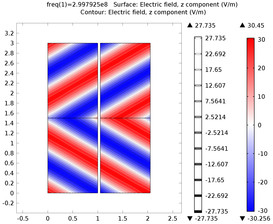
It is possible to engineer the structure of materials such that both the permittivity and permeability are negative. Such materials are realized by engineering a periodic structure with features comparable in scale to the wavelength. It is possible to model both the individual unit cells ... En savoir plus
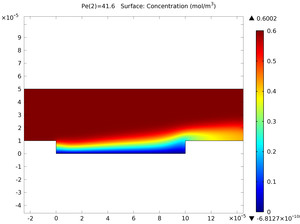
This model demonstrates the impact of convection and diffusion on the transport-limited electrodeposition of a copper microconnector bump (metal post). Microconnector bumps are used in various types of electronic applications for interconnecting components, for instance liquid crystal ... En savoir plus

This app is an example of how the poroelastic properties of a porous material can be determined based on measurement done with an impedance tube and parameter estimation. Being able to determine the characteristics of a porous material from a single and simple measurement opens the door ... En savoir plus
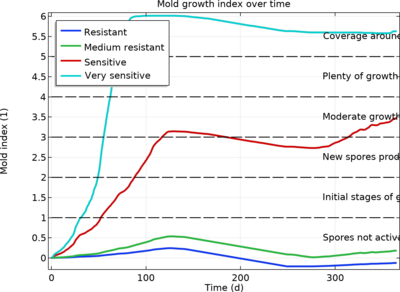
This tutorial demonstrates how to use the temperature and relative humidity computed from a heat and moisture transport simulation of an insulated roof as inputs for a mold prediction model. The VTT model for mold growth and decline prediction calculates a mold index M by solving an ... En savoir plus

The Pipe Flow interface allows you to simulate non-Newtonian fluids flowing in pipes. This example models a coal slurry being transported in a pipe system where the pipe diameter changes in different sections. The slurry behaves as a non-Newtonian fluid described by the power law model. ... En savoir plus

This tutorial demonstrates how to simulate coupled heat and moisture transport in an insulated roof structure composed of a load-bearing layer and an insulation layer. The thermal insulation faces the interior, while a moisture barrier is placed on the exterior side. The load-bearing ... En savoir plus

Formally known as size separation in vibrated granular materials, the Brazil nut effect (BNE) (and sometimes the Muesli effect) is a phenomenon that causes large grains to separate from small ones and rise to the top of a granular bed under vibrations. This phenomenon can be studied ... En savoir plus

In this example, a heat transfer model of a fiber composite's unit cell is analyzed with the Cell Periodicity feature. The homogenized thermal conductivity, density and heat capacity of a composite material are computed based on the individual properties of fiber and matrix. A comparison ... En savoir plus

This is a busbar configuration with an AC analysis. The configuration is similar to the introductory tutorial in the book Introduction to COMSOL Multiphysics. However, two conductors are added to represent a more realistic case of magnetic fields surrounding the busbar. The results ... En savoir plus


