
La Bibliothèque d'Applications présente des modèles construits avec COMSOL Multiphysics pour la simulation d'une grande variété d'applications, dans les domaines de l'électromagnétisme, de la mécanique des solides, de la mécanique des fluides et de la chimie. Vous pouvez télécharger ces modèles résolus avec leur documentation détaillée, comprenant les instructions de construction pas-à-pas, et vous en servir comme point de départ de votre travail de simulation. Utilisez l'outil de recherche rapide pour trouver les modèles et applications correspondant à votre domaine d'intérêt. Notez que de nombreux exemples présentés ici sont également accessibles via la Bibliothèques d'Applications intégrée au logiciel COMSOL Multiphysics® et disponible à partir du menu Fichier.

A simple model for groundwater contamination portrays a well that is bored into an aquifer. The aquifer consists of a partially saturated layer and a fully saturated layer. The model investigates how much of the contaminant ends up in the well after a contaminant is introduced in the ... En savoir plus
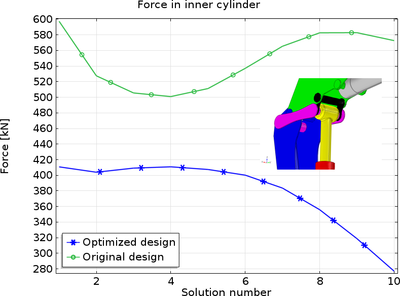
In complex mechanical systems, it can be challenging to find an optimal (or even good enough) solution only through engineering insight or trial-and-error procedures. Using mathematical optimization methods can then be an efficient path to a better design. In this example, a link ... En savoir plus
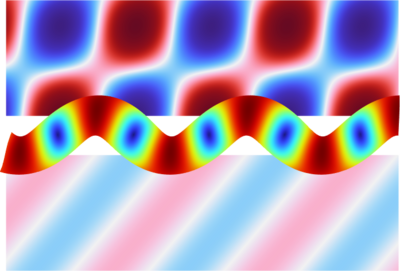
In this model, two fluids are separated by a solid elastic structure. An acoustic pressure wave impacts the structure resulting in a reflected wave and a wave transmitted with a loss through the structure. This model investigates the transmission loss through the structure. The effects ... En savoir plus
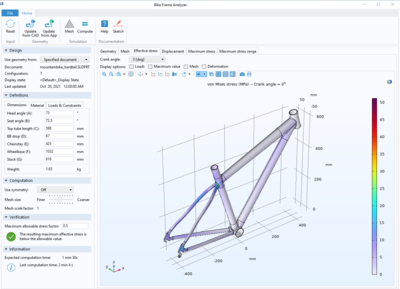
The reliability of a bike frame can be estimated by analyzing the structural stress subjected to different load cases. This app leverages LiveLink™ for SOLIDWORKS® to interactively update the geometry while computing stress analyses. Using this app, you can easily test different ... En savoir plus
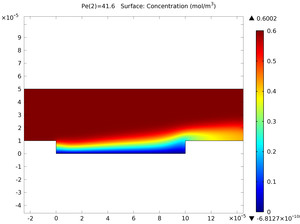
This model demonstrates the impact of convection and diffusion on the transport-limited electrodeposition of a copper microconnector bump (metal post). Microconnector bumps are used in various types of electronic applications for interconnecting components, for instance liquid crystal ... En savoir plus
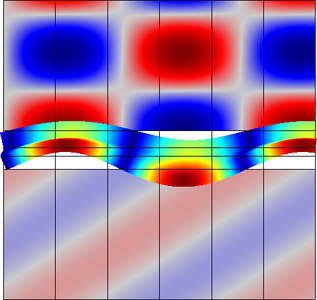
In this model, two fluids are separated by a multilayer solid elastic structure. An acoustic pressure wave impacts the structure resulting in a reflected wave and a transmitted wave with a loss through the structure. This model investigates the transmission loss through the structure. ... En savoir plus

This is a transient model of an electromagnetic plunger with stopper restricting the linear motion. The model consists of a magnetic core, nonmagnetic guider, multi-turn coil, nonmagnetic stopper/blocker, and magnetic plunger attached to the spring and damper at the base. The ... En savoir plus

This model demonstrates three different ways to find the eigenfrequencies of a rectangular metallic cavity. The first method uses an eigenfrequency study step together with the Electromagnetic Waves, Beam Envelopes interface. Here, it is important to define a wave vector for the physics ... En savoir plus

These examples show how to use the tools under the Results node to generate and visualize randomized material data with prescribed statistical properties. The randomness is controlled through a spectral density distribution, which defines the spatial frequency content of the material ... En savoir plus
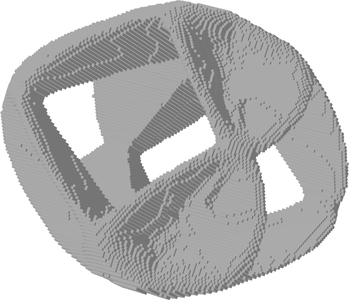
Topology optimization is associated with extreme design freedom which can yield extreme performance. The designs can be easier to manufacture by using milling constraints, at some cost to the performance. This example considers the case of a torsion sphere which is known to feature a ... En savoir plus


