
La Bibliothèque d'Applications présente des modèles construits avec COMSOL Multiphysics pour la simulation d'une grande variété d'applications, dans les domaines de l'électromagnétisme, de la mécanique des solides, de la mécanique des fluides et de la chimie. Vous pouvez télécharger ces modèles résolus avec leur documentation détaillée, comprenant les instructions de construction pas-à-pas, et vous en servir comme point de départ de votre travail de simulation. Utilisez l'outil de recherche rapide pour trouver les modèles et applications correspondant à votre domaine d'intérêt. Notez que de nombreux exemples présentés ici sont également accessibles via la Bibliothèques d'Applications intégrée au logiciel COMSOL Multiphysics® et disponible à partir du menu Fichier.
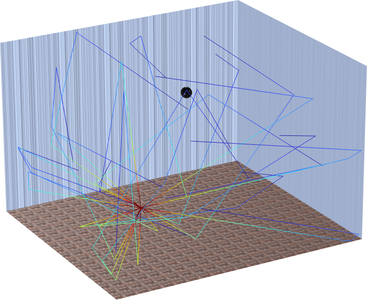
This model shows one approach for obtaining a broadband impulse response by combining ray-tracing and finite element methods. The combination is done all within COMSOL® and uses idealized filters. In this example, the simulation results are further compared to an analytical solution ... En savoir plus
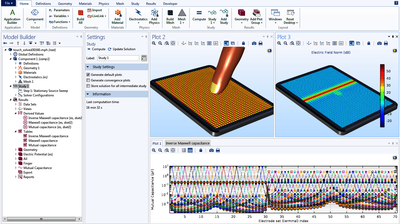
Intended as a tool for early proof of concept in capacitive touchscreen device development, the Touchscreen Simulator app evaluates a simulated capacitance matrix as well as the electric field norm. The app computes the capacitance matrix of a touchscreen in the presence of a human ... En savoir plus

This simple tutorial model shows how to set up a parametric sweep over a number of frequency bands (octaves or 1/3 octaves) and remesh once per band. A frequency sweep is performed within each band, which now has an adequate mesh resolution. This approach saves some computational effort ... En savoir plus
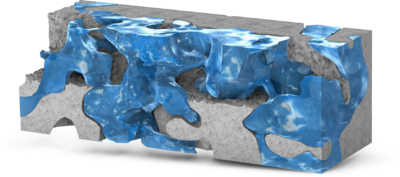
Digital Rock technology utilizes high-resolution imaging techniques, such as SEM and X-ray CT, to characterize the pore structures of rock cores. This approach enables pore-scale modeling of reservoir rocks, offering valuable insights into pore morphology, connectivity, and fluid ... En savoir plus

In this model, you build and solve a 2D beam model using the 2D Structural Mechanics Beam interface. This model describes the eigenfrequency analysis of a simple geometry. A point mass and point mass moment of inertia are used in the model. The two first eigenfrequencies are compared ... En savoir plus
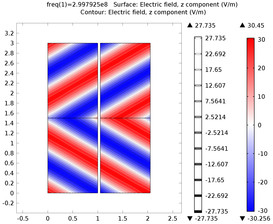
It is possible to engineer the structure of materials such that both the permittivity and permeability are negative. Such materials are realized by engineering a periodic structure with features comparable in scale to the wavelength. It is possible to model both the individual unit cells ... En savoir plus

Electrochemical codeposition is a common low-cost method for producing metal alloys. This tutorial model demonstrates electrodeposition of a nickel (Ni)–phosphorous (P) alloy. The model accounts for charge and mass transport of a multitude of species along with multiple electrode ... En savoir plus

This model demonstrates the motion of a bicycle with a hands-free rider when given an initial forward velocity and perturbed with a lean about the forward axis. This is implemented through the Multibody Dynamics module in COMSOL. The wheels of the bicycle have been modelled assuming ... En savoir plus

This tutorial demonstrates the use of the Heat and Moisture Flow predefined interface for the modeling of heat transfer and moisture transport in a turbulent air flow, with the quantification of evaporation and condensation on surfaces, and the automatic handling of the associated latent ... En savoir plus

This model computes the fundamental eigenfrequency and eigenmode for a tuning fork that is synchronized from PTC Creo Parametric™ via the LiveLink™ interface. The length of the fork is then optimized so that the tuning fork sounds the note A, 440 Hz. En savoir plus


