
La Bibliothèque d'Applications présente des modèles construits avec COMSOL Multiphysics pour la simulation d'une grande variété d'applications, dans les domaines de l'électromagnétisme, de la mécanique des solides, de la mécanique des fluides et de la chimie. Vous pouvez télécharger ces modèles résolus avec leur documentation détaillée, comprenant les instructions de construction pas-à-pas, et vous en servir comme point de départ de votre travail de simulation. Utilisez l'outil de recherche rapide pour trouver les modèles et applications correspondant à votre domaine d'intérêt. Notez que de nombreux exemples présentés ici sont également accessibles via la Bibliothèques d'Applications intégrée au logiciel COMSOL Multiphysics® et disponible à partir du menu Fichier.
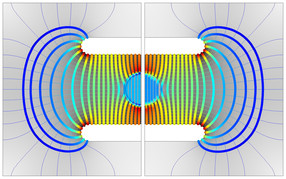
The dielectric shielding boundary condition is meant to approximate a thin layer of material with high relative permittivity compared to its surroundings. This boundary condition is available for electrostatic field modeling. This example compares the dielectric shielding boundary ... En savoir plus

The graviational three body problem involves the calculation of the positions and velocities of three objects under mutual gravitational attraction, given their position and velocity at some initial time. While the three-body problem does not have a general analytic solution and is ... En savoir plus
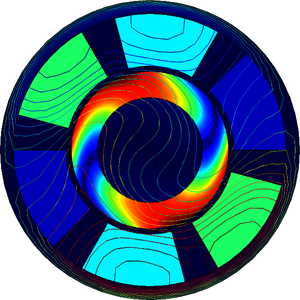
This three-phase induction motor model is used to compare with Testing Electromagnetic Analysis Method (TEAM) workshop problem 30. The Magnetic Fields physics interface is used to model the motor in the frequency domain at 60 Hz. The Velocity (Lorentz Term) feature is used to model the ... En savoir plus

This benchmark model simulates a graded heterojunction using the thermionic emission formulation for the charge transfer over the junction. It shows the additional contribution to the current density from the quantum tunneling effect across the potential barrier, using the WKB ... En savoir plus
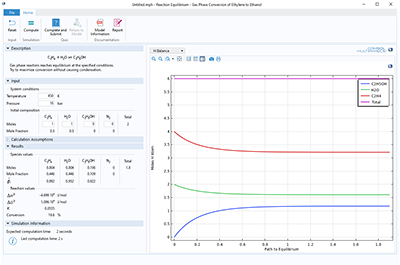
This app demonstrates the following: How an app can be used as a teaching tool An 8 question multiple choice quiz where the answers can be sent to the grader by email This app calculates the equilibrium compositions in gas phase conversion of ethylene to ethanol. It allows you to ... En savoir plus

This example reproduces parts of the study of Ref. 1 on the thermal contact resistance at the interface between a heat sink and an electronic package. Eight cooling fins equip the cylindrical heat sink and contact is made at the radial boundaries of the package. The efficiency of the ... En savoir plus
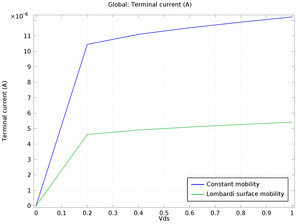
Surface acoustic phonons and surface roughness have an important effect on the carrier mobility, especially in the thin inversion layer under the gate in MOSFETs. The Lombardi surface mobility model adds surface scattering resulting from these effects to an existing mobility model using ... En savoir plus
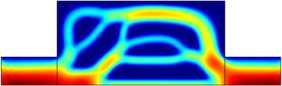
In this application, a solution is pumped through a catalytic bed where a solute species reacts as it gets in contact with the catalyst. The purpose of this example is to maximize the total reaction rate for a given total pressure difference across the bed by finding an optimal catalyst ... En savoir plus
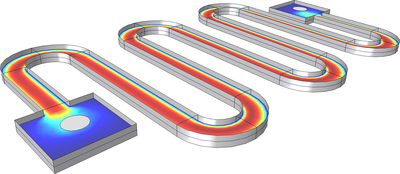
Removing halogen groups from hydrocarbons is an important reaction step in several chemical processes. One application is water purification. Other examples involve organic synthesis, where the removal of halogen groups serves as a starting point for carbon-carbon coupling reactions. ... En savoir plus
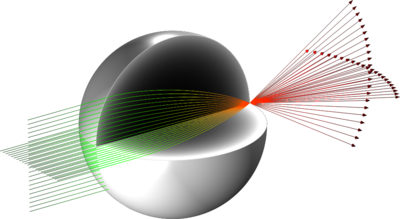
A Luneburg lens is a type of graded index, or GRIN lens, in which the gradient of the refractive index leads to special focusing properties. This example model uses the Geometrical Optics interface to compute the curved ray trajectories in the graded-index medium. En savoir plus


