
La Bibliothèque d'Applications présente des modèles construits avec COMSOL Multiphysics pour la simulation d'une grande variété d'applications, dans les domaines de l'électromagnétisme, de la mécanique des solides, de la mécanique des fluides et de la chimie. Vous pouvez télécharger ces modèles résolus avec leur documentation détaillée, comprenant les instructions de construction pas-à-pas, et vous en servir comme point de départ de votre travail de simulation. Utilisez l'outil de recherche rapide pour trouver les modèles et applications correspondant à votre domaine d'intérêt. Notez que de nombreux exemples présentés ici sont également accessibles via la Bibliothèques d'Applications intégrée au logiciel COMSOL Multiphysics® et disponible à partir du menu Fichier.

In the search for weight reduction, the cross-section of an eyeglass frame is continuously reduced. The thin section over the nose transfers the entire load between the two halves. This example predicts the fatigue life using the combined Basquin and Coffin-Manson model when eyeglasses ... En savoir plus

This conceptual model analyzes the influence of leaks on the acoustic response of an earbud speaker placed in an ear-canal-like geometry. Built-in impedance models are used to capture the effects of a perforated plate in front of the speaker, skin impedance, and ear drum impedance. The ... En savoir plus

Piezoelectric microblowers are compact, lightweight air pumps with varying applications including electronics cooling and airflow related medical devices. The device consists of a PZT-brass diaphragm and a specially designed housing including a pumping chamber, air inlet and outlet ... En savoir plus
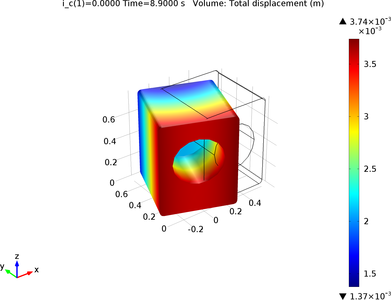
Walking instability, due to non-uniform distribution of clothes, is a common problem in lightweight portable washing machines. This problem is more severe in horizontal-axis washing machines, which are more popular because of their high efficiency in spite of high manufacturing cost. ... En savoir plus

This model describes the pressure wave propagation in a muffler for an internal combustion engine. The purpose of the model is to show how to analyze both inductive and resistive damping in pressure acoustics as well as coupling the fluid to the surrounding elastic shell structure of the ... En savoir plus
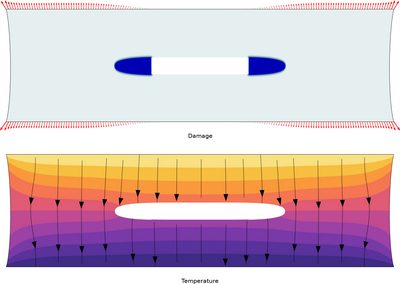
This model demonstrates how to set up a phase field damage multiphysics model to predict crack propagation in thermoelastic solids under large deformations. The crack-driving force depends on the principal stresses, which in turn depend on the temperature distribution in the solid ... En savoir plus

This model demonstrates how to set up a dynamic simulation that includes several contact interactions, including friction, using a single general contact pair. The dynamics is solved using explicit time stepping. En savoir plus
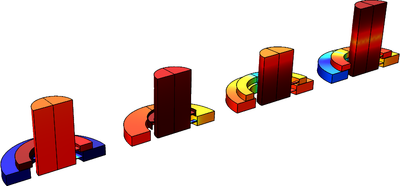
In this tutorial the geometry of an occluded ear-canal simulator is optimized to match the acoustic response of a given ear. The target data in this model stems from a simulation of an ear canal, but it can also be based on measurements, or a response specified by a standard. En savoir plus
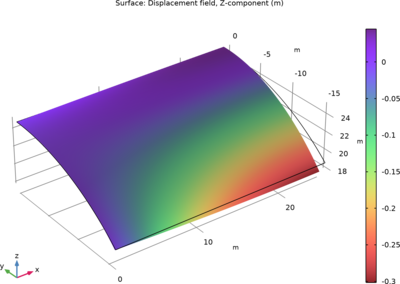
In this example a thin curved membrane is built and solved using the Shell interface. This model is a widely used benchmark model denoted the Scordelis-Lo roof. The computed maximum z-deformation is compared with the value given in Proposed Standard Set of Problems to Test Finite ... En savoir plus
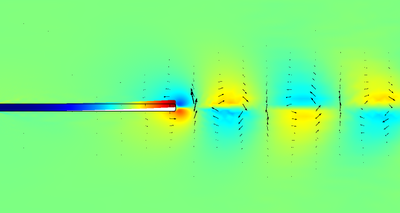
This is a small 2D demonstration model that couples the Linearized Navier-Stokes, Frequency Domain, Solid Mechanics, and Turbulent Flow (k-epsilon) physics interfaces to model the vibrations of a plate located in a 2D viscous parallel plate flow. This type of model is used to model fluid ... En savoir plus


