
La Bibliothèque d'Applications présente des modèles construits avec COMSOL Multiphysics pour la simulation d'une grande variété d'applications, dans les domaines de l'électromagnétisme, de la mécanique des solides, de la mécanique des fluides et de la chimie. Vous pouvez télécharger ces modèles résolus avec leur documentation détaillée, comprenant les instructions de construction pas-à-pas, et vous en servir comme point de départ de votre travail de simulation. Utilisez l'outil de recherche rapide pour trouver les modèles et applications correspondant à votre domaine d'intérêt. Notez que de nombreux exemples présentés ici sont également accessibles via la Bibliothèques d'Applications intégrée au logiciel COMSOL Multiphysics® et disponible à partir du menu Fichier.
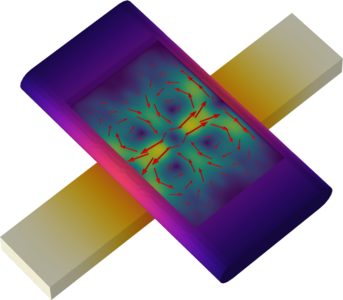
A 3D model of an acoustic trap in a glass capillary actuated by a piezoelectric transducer. The system is actuated by an oscillating electric potential across the piezoelectric transducer inducing mechanical vibrations in the solid and an acoustic pressure field in the fluid. The heat ... En savoir plus

Creep is an inelastic time-dependent deformation which occurs when a material is subjected to stress at sufficiently high temperature, say 40% of the melting point or more. Experimental creep data (using constant stress and temperature) often display three different types of behavior ... En savoir plus
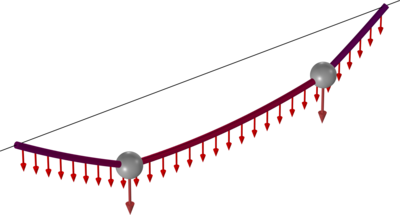
A cable is a structural member which has stiffness only in its tangential direction, but virtually no bending stiffness. When supported only at its two ends it deflects under gravitational load forming a curve known as catenary. This example shows how to model components such as cables, ... En savoir plus

This tutorial model shows a virtual test setup of a conference speaker. The speaker system consists of a loudspeaker as well as three microphones. The model instigates the loudspeaker sound radiation, feedback, as well as the ability of the system to detect sound (speech) emitted from a ... En savoir plus

This is a model of a simple thermoacoustic engine that includes a thermal stack to convert thermal energy to acoustic energy. The model is set up using two approaches: 1) Using a linear perturbation (acoustic) approaches solving the fluid motion with the Thermoviscous Acoustics, ... En savoir plus

This model shows how to include the nonlinear (large signal) behavior of certain lumped components in a simplified loudspeaker analysis. The mechanical and electrical system is modeled using an equivalent electrical circuit. The large signal compliance CMS(x) and force factor BL(x) are ... En savoir plus

A standing contact fatigue test is a procedure used for testing crack growth on the subsurface level. In such a test, a spherical object is pressed against the tested materials and cycled between a high and low compressive load. No translational movement between the two occurs. After a ... En savoir plus
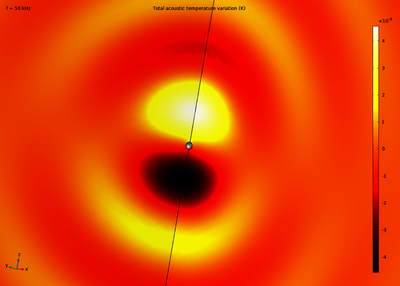
This tutorial simulates a small vibrating hemispherical particle in water. The particle has a radius of 1 mm and is oscillating in the axial direction at a frequency of 50 kHz. The vibrations induce acoustic waves in the fluid. The example demonstrates how to set up a thermoviscous ... En savoir plus

In this example, the eigenmodes of a structural damper are computed. In the damper, most of the deformation is controlled by the viscoelastic domains, which have strongly frequency-dependent stiffness and damping properties. This leads to a nonlinear eigenfrequency problem, which can be ... En savoir plus

This tutorial model shows how to model a microspeaker located in a smart phone including the radiation through and interaction with the acoustic port that connects to the exterior. The model demonstrates a linear frequency domain analysis as well as a nonlinear time domain analysis. A ... En savoir plus