
La Bibliothèque d'Applications présente des modèles construits avec COMSOL Multiphysics pour la simulation d'une grande variété d'applications, dans les domaines de l'électromagnétisme, de la mécanique des solides, de la mécanique des fluides et de la chimie. Vous pouvez télécharger ces modèles résolus avec leur documentation détaillée, comprenant les instructions de construction pas-à-pas, et vous en servir comme point de départ de votre travail de simulation. Utilisez l'outil de recherche rapide pour trouver les modèles et applications correspondant à votre domaine d'intérêt. Notez que de nombreux exemples présentés ici sont également accessibles via la Bibliothèques d'Applications intégrée au logiciel COMSOL Multiphysics® et disponible à partir du menu Fichier.

Computing molecular flows in arbitrary geometries produces complex integral equations that are very difficult to compute analytically. Analytic solutions are, therefore, only available for simple geometries. One of the earliest problems solved was that of gas flow through tubes of ... En savoir plus
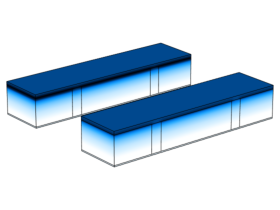
This tutorial model compares the results between a domain approach and the Thin Moisture Barrier feature to simulate the moisture transport in a wall with a vapor barrier. The Thin Moisture Barrier feature neglects diffusion, two studies are proposed, a first one where diffusion is ... En savoir plus
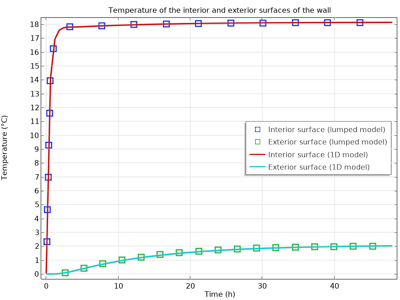
This model performs a transient analysis of the temperature through a house wall. The wall is formed of different layers corresponding to the structure, insulation and plaster. On the exterior and the interior, the wall is exposed to thermal radiation and convective cooling. The results ... En savoir plus
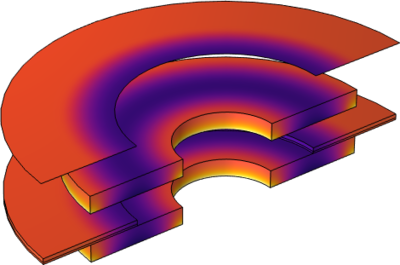
This tutorial model demonstrates the use of the multiphysics coupling feature Thermal Connection, Layered Shell, Surfaces. In this model, one layered shell is connected to heat domains by a facing boundary. The results obtained with the Heat Transfer in Shells interface are compared with ... En savoir plus
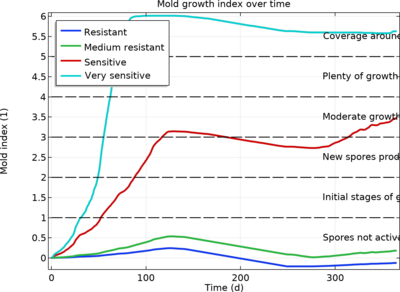
This tutorial demonstrates how to use the temperature and relative humidity computed from a heat and moisture transport simulation of an insulated roof as inputs for a mold prediction model. The VTT model for mold growth and decline prediction calculates a mold index M by solving an ... En savoir plus
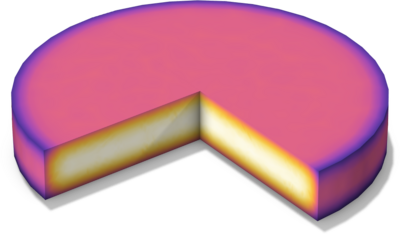
The purpose of this model is to introduce the Semitransparent Surface Feature from the Radiation in Participating Media Interface. It is a variation of the Radiative Cooling of a Glass Plate model with the DOM method. In this version a semitransparent surface is defined on external ... En savoir plus
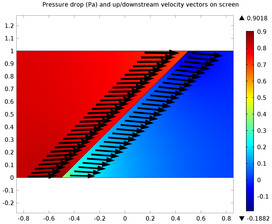
This model simulates the flow through a uniform inclined screen using the Screen feature in Single-Phase Flow physics and compares the results with an analytic solution. En savoir plus

A simple model for groundwater contamination portrays a well that is bored into an aquifer. The aquifer consists of a partially saturated layer and a fully saturated layer. The model investigates how much of the contaminant ends up in the well after a contaminant is introduced in the ... En savoir plus

Turbulent flow, SSG-LRR interface is employed to investigate turbulent flow in a straight semicircular duct. The resulting flow pattern is characterized by slow secondary motions in the plane normal to the duct axis. The order of magnitude of velocity of those motions is 1% of the ... En savoir plus
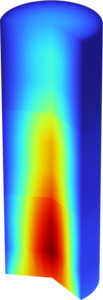
This model simulates a cylindrical furnace with isotropic scattering. It validates the use of the Discrete Ordinates Method for 2D axisymmetric cases, comparing the results with the highly accurate Monte Carlo method. The setup and reference Monte Carlo values are given in: R .P. Gupta, ... En savoir plus


