
La Bibliothèque d'Applications présente des modèles construits avec COMSOL Multiphysics pour la simulation d'une grande variété d'applications, dans les domaines de l'électromagnétisme, de la mécanique des solides, de la mécanique des fluides et de la chimie. Vous pouvez télécharger ces modèles résolus avec leur documentation détaillée, comprenant les instructions de construction pas-à-pas, et vous en servir comme point de départ de votre travail de simulation. Utilisez l'outil de recherche rapide pour trouver les modèles et applications correspondant à votre domaine d'intérêt. Notez que de nombreux exemples présentés ici sont également accessibles via la Bibliothèques d'Applications intégrée au logiciel COMSOL Multiphysics® et disponible à partir du menu Fichier.

This model shows modeling of a sphere falling on a water surface. Specifically, it models the oscillating motion of a buoyant sphere as it falls through air and interacts with the air-water interface to finally float on water. Get more details in our blog post: Modeling a Sphere Falling ... En savoir plus
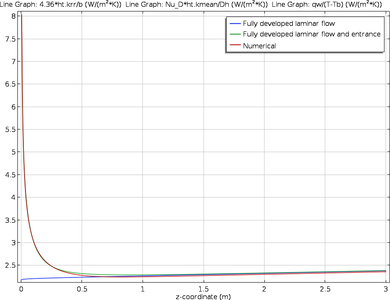
This verification model of nonisothermal laminar flow through a circular tube compares the heat transfer coefficient obtained from simulation with theoretical values based on Nusselt number correlation functions that can be found in the literature. En savoir plus
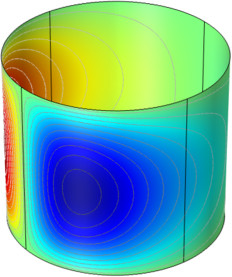
Journal bearings are used to carry radial loads, for example, to support a rotating shaft. A simple journal bearing consists of two rigid cylinders. The outer cylinder (bearing) wraps the inner rotating journal (shaft). The new thin-film flow user interfaces of the CFD Module enables ... En savoir plus

This tutorial model illustrates the use of the nucleate boiling heat flux features to compute the transient cooling of a cylindrical rod plated with nickel, and immersed in a pool of boiling water. The temperature and heat flux results obtained with a 3D time-dependent computation, with ... En savoir plus
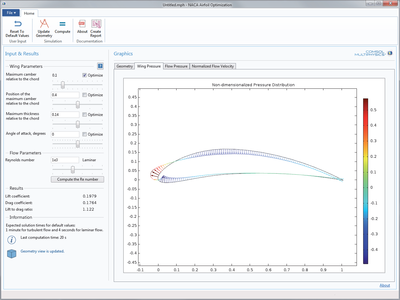
The aerodynamic properties of a wing, propeller, or turbine blade are to a large extent determined by the precise shape of the airfoil that is used. The NACA Airfoil Optimization application computes the two main aerodynamic properties (the lift and drag coefficients) of a fully ... En savoir plus
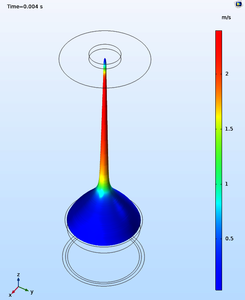
This model deals with electrohydrodynamics (EHD), where a charge separation on the phase boundary between a liquid and air involves the formation of a charged layer. This charged layer allows for a net force to be induced at the interphase when a large electric field is applied. The ... En savoir plus

This tutorial shows how to use the Radiative Beam in Absorbing Media interface (Heat Transfer Module) to model the attenuation of a laser light going through a sample of silica glass, and the heat source generated by the absorption. En savoir plus
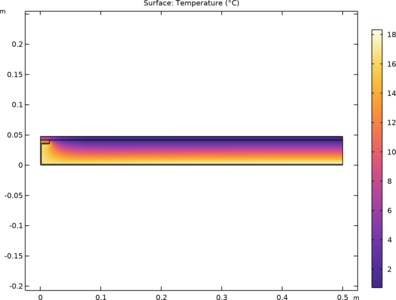
This example studies heat transfer in a composite two-dimensional structure. Four materials with distinct thermal conductivities k compose the structure. The top and bottom boundaries are facing environments respectively at 0°C and 20°C. The temperature distribution and the heat flux ... En savoir plus

This model evaluates the temperature distribution in 3 buried cables in a situation where the soil surface temperature is known. The temperature profile obtained with a thermal circuit approach for the cables is compared with a FEM approach. The thermal circuit properties are established ... En savoir plus

This tutorial model illustrates how to calculate the pressure drop and initial flow rate in a pipe system connected to water tank. The Pipe Flow interface contains ready to use friction models accounting for the surface roughness of pipes as well as pressure losses in bends and valves. En savoir plus


