
La Bibliothèque d'Applications présente des modèles construits avec COMSOL Multiphysics pour la simulation d'une grande variété d'applications, dans les domaines de l'électromagnétisme, de la mécanique des solides, de la mécanique des fluides et de la chimie. Vous pouvez télécharger ces modèles résolus avec leur documentation détaillée, comprenant les instructions de construction pas-à-pas, et vous en servir comme point de départ de votre travail de simulation. Utilisez l'outil de recherche rapide pour trouver les modèles et applications correspondant à votre domaine d'intérêt. Notez que de nombreux exemples présentés ici sont également accessibles via la Bibliothèques d'Applications intégrée au logiciel COMSOL Multiphysics® et disponible à partir du menu Fichier.

Permanent magnet bearings are used in turbomachinery, pumps, motors, generators, and flywheel energy storage systems, to mention a few application areas; contactless operation, low maintenance, and the ability to operate without lubrication are some key benefits compared to conventional ... En savoir plus
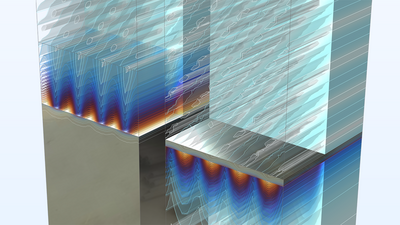
This example demonstrates a simulation setup for exciting surface plasmon polaritons using Otto and Kretschmann configurations. The underlying mechanism is enabled by the interplay between total internal reflection and evanescent-wave coupling phenomena. It also calculates the ... En savoir plus

This example builds surrogate models with deep neural network (DNN) training to quickly estimate the performance of a microstrip patch antenna based on four design parameters: patch length, tuning stub length, dielectric constant of a substrate, and frequency. The model also simulates a ... En savoir plus

This model analyzes the thermal expansion in a MEMS device, such as a microgyroscope, where thermal expansion should be minimized. The device is made from the copper-beryllium alloy UNS C17500 and uses temperature-dependent material properties from the Material Library. The purpose of ... En savoir plus
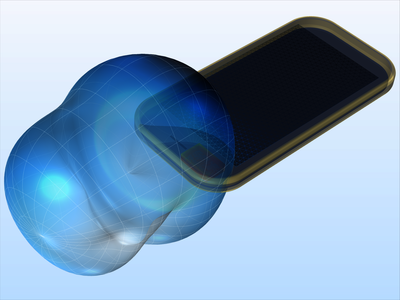
Electrical components in wireless communication systems are designed to be small and lightweight while maintaining decent performance and efficiency. Antennas are essential components in mobile devices and are required to fit in the limited space allowed by industrial specifications. To ... En savoir plus

This benchmark model compares the damping coefficients of perforated plates from computation results versus experimental data. The simulation includes 18 different geometric configurations. It uses the Bao's perforation model, which is built-in in the Thin Film Flow physics interface. ... En savoir plus
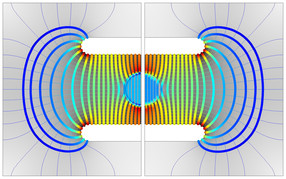
The dielectric shielding boundary condition is meant to approximate a thin layer of material with high relative permittivity compared to its surroundings. This boundary condition is available for electrostatic field modeling. This example compares the dielectric shielding boundary ... En savoir plus

An antenna array is a group of radiating elements. By controlling the phase and magnitude of the input signal assigned to each antenna element and the number of array elements, the radiation pattern can be steered in a desired direction with a preferred level of gain. In this example, a ... En savoir plus
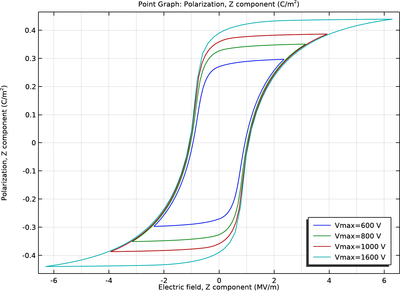
Ferroelectric materials exhibit nonlinear polarization behavior such as hysteresis and saturation at large applied electric fields. Many piezoelectric materials are ferroelectric. This model analyzes a simple actuator made of PZT piezoelectric ceramic material, which is subjected to ... En savoir plus
This benchmark model computes the total force acting on a vibrating disc in the frequency and time domains and compares both results with expressions derived analytically. When the vibration amplitude is small enough that the system is linear the frequency and time domain results agree ... En savoir plus


