
La Bibliothèque d'Applications présente des modèles construits avec COMSOL Multiphysics pour la simulation d'une grande variété d'applications, dans les domaines de l'électromagnétisme, de la mécanique des solides, de la mécanique des fluides et de la chimie. Vous pouvez télécharger ces modèles résolus avec leur documentation détaillée, comprenant les instructions de construction pas-à-pas, et vous en servir comme point de départ de votre travail de simulation. Utilisez l'outil de recherche rapide pour trouver les modèles et applications correspondant à votre domaine d'intérêt. Notez que de nombreux exemples présentés ici sont également accessibles via la Bibliothèques d'Applications intégrée au logiciel COMSOL Multiphysics® et disponible à partir du menu Fichier.
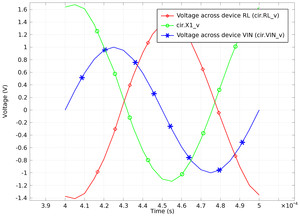
This model shows how to combine an electric circuit simulation with a finite element simulation. The finite element model is an inductor with a nonlinear magnetic core and 1000 turns, where the number of turns is modeled using a distributed current technique. The circuit is imported ... En savoir plus
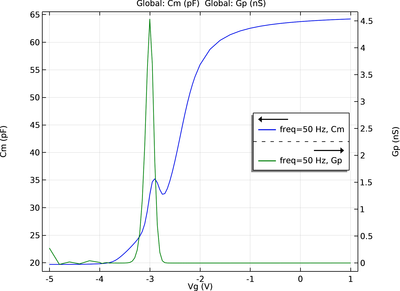
This tutorial compares experimental data from the literature with a COMSOL model of a MOSCAP with interface traps (surface states). The Trap-Assisted Surface Recombination feature is used to simulate the effects of the trap charges and the processes of carrier capturing and emitting by ... En savoir plus

The model analyses the mode propagation within a nano slot waveguide. In a slot waveguide configuration, two high refractive index slabs (~3.48) are placed adjacent to the low refractive index slot (~1.44). Mode analysis was performed on a 2D cross section of a slot waveguide for an ... En savoir plus

This tutorial model presents a study of a double-headed streamer in nitrogen at atmospheric pressure. An initial seed of electrons is placed between two electrodes which apply an initial electric field of 52 kV/cm to the gas. A negative and positive streamer propagate toward the ... En savoir plus

A waveguide filter is designed using shape optimization by moving and scaling rectangles in the geometry. The irises of the initial geometry are optimized to ensure good bandpass response and out-of-band rejection, while maintaining the double mirror symmetry. En savoir plus
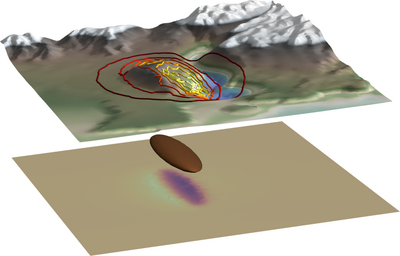
Magnetic prospecting is a geological exploration method that is applicable to certain types of iron ore deposits, in particular those made up of magnetite and hematite. The method consists of measuring the magnetic anomalies (changes in the earth's magnetic field) due to the presence of ... En savoir plus

Thermoelectric coolers are widely used for electronics cooling in various application areas, ranging from consumer products to spacecraft design. The thermoelectric modules are a common application of thermoelectricity in cooling engineering. They consist of several thermoelectric legs ... En savoir plus

A magnet moving axially through the center of a coil will induce a voltage across the coil terminals. One practical application of this is in shaker flashlights, where the flashlight is vigorously shaken back and forth, causing a magnet to move through a multi-turn coil, which provides ... En savoir plus

This verification model uses the Electromagnetic Waves, Boundary Elements interface to simulate the RCS of perfectly conducting sphere. The simulated result is compared to analytical calculation to verify the accuracy. En savoir plus
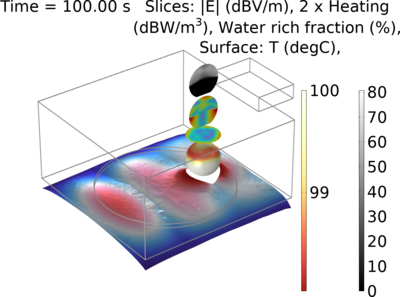
A spherical water-rich load (potato) is placed on the rotating glass tray of a microwave oven some distance from the center of rotation. 1 kW of 2.45 GHz microwave power is applied via a waveguide feed. The plate rotates at 9 degrees per second. The heat transfer model involves the ... En savoir plus


