
La Bibliothèque d'Applications présente des modèles construits avec COMSOL Multiphysics pour la simulation d'une grande variété d'applications, dans les domaines de l'électromagnétisme, de la mécanique des solides, de la mécanique des fluides et de la chimie. Vous pouvez télécharger ces modèles résolus avec leur documentation détaillée, comprenant les instructions de construction pas-à-pas, et vous en servir comme point de départ de votre travail de simulation. Utilisez l'outil de recherche rapide pour trouver les modèles et applications correspondant à votre domaine d'intérêt. Notez que de nombreux exemples présentés ici sont également accessibles via la Bibliothèques d'Applications intégrée au logiciel COMSOL Multiphysics® et disponible à partir du menu Fichier.

This tutorial model solves for an inductively coupled plasma reactor in a mixture of SF6/argon. The model computes the fluid flow and gas heating. Important aspects and strategies for modeling electronegative discharges are discussed. En savoir plus

This is a simple yet powerful simulation app for designing a two-dimensional reflective metalens. This metalens consists of a array of glass nanopillars on a metal substrate. Initially, the app determines the optimal grating parameters for a specific wavelength and calculates the ... En savoir plus

Although initially invented to be used in printers, inkjets have been adopted for other application areas, such as within the life sciences and microelectronics. Simulations can be useful to improve the understanding of the fluid flow and to predict the optimal design of an inkjet for a ... En savoir plus

This model demonstrates how to use the chatbot functionality in COMSOL Multiphysics® to add annotations to a model of a pacemaker electrode. To learn more about this model, see our accompanying blog post “Using the Chatbot Window in COMSOL Multiphysics®”. En savoir plus

This 3D model example demonstrates the use of the Lead-Acid Battery interface for modeling current distribution in full cell employing a lead-acid battery chemistry. The lead acid battery chemistry uses PbO2 as the positive porous electrode and Pb as the negative porous electrode and ... En savoir plus

The purpose of this model is to visualize the electric potential in an electrochemical cell, for example a battery. This is done at OCV and during operation. In a battery, this would correspond to OCV, discharge, and recharge. The potential profile is explained both for cells with planar ... En savoir plus

The Rowland circle is a circle of radius R that lies tangent to a concave curved diffraction grating of radius 2R. If the entrance slit of incoming light is positioned on this circle, then rays reflected by the grating will be focused at various points along the same circle based on ... En savoir plus

This is a model of a simple Sagnac interferometer consisting of two mirrors and a beam splitter arranged in a triangle. The entire modeling domain rotates; as a result, the rays propagating in opposite directions in the triangle have different optical path lengths due to the Sagnac ... En savoir plus
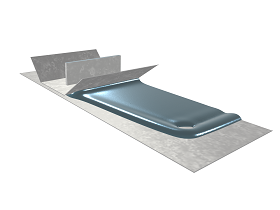
This is a tutorial of a slot die coating process in 3D where the channel is obstructed. The example uses a two-phase flow phase-field method with a non-Newtonian power-law fluid. The effects on the film thickness of the channel obstruction can clearly be seen. En savoir plus
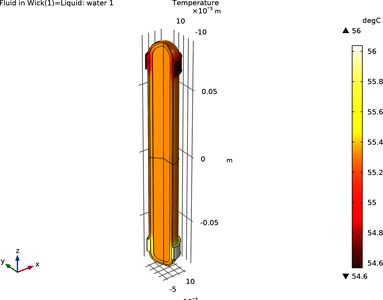
Heat pipes are designed to transfer heat efficiently through vaporization, mass transfer, and condensation of a working fluid. They are found in a wide variety of applications where thermal control is of importance, with cooling of electronics being a prominent example. Inside a heat ... En savoir plus


