
La Bibliothèque d'Applications présente des modèles construits avec COMSOL Multiphysics pour la simulation d'une grande variété d'applications, dans les domaines de l'électromagnétisme, de la mécanique des solides, de la mécanique des fluides et de la chimie. Vous pouvez télécharger ces modèles résolus avec leur documentation détaillée, comprenant les instructions de construction pas-à-pas, et vous en servir comme point de départ de votre travail de simulation. Utilisez l'outil de recherche rapide pour trouver les modèles et applications correspondant à votre domaine d'intérêt. Notez que de nombreux exemples présentés ici sont également accessibles via la Bibliothèques d'Applications intégrée au logiciel COMSOL Multiphysics® et disponible à partir du menu Fichier.

This model simulates atmospheric galvanic corrosion of an aluminum alloy in contact with steel. The electrolyte film thickness depends on the relative humidity of the surrounding air and the salt load density of NaCl crystals on the metal surface. Empirical expressions for the oxygen ... En savoir plus
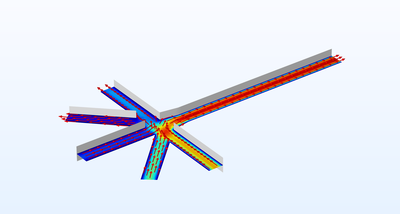
This model presents a time-dependent study of a microchannel that is used to infuse and flush another piece of equipment with a fluid. The pressure at the five inlets varies sinusoidally as functions of time, and the velocity vector at the outlet is studied. The model uses an ... En savoir plus

Mixed-mode S-parameters describe the responses of a circuit with balanced ports excited and terminated by two types of modes: common and differential modes. They are calculated using a full S-parameter matrix of a four-port network that is composed of four single ended lines. This ... En savoir plus

This model serves the purpose of validation and verification of the Linear Elastic Material, Layered model in the Shell interface. In COMSOL Multiphysics, composites are analyzed either based on Layerwise 3D elasticity theory through the Layered Shell interface or based on FSDT-ESL ... En savoir plus

Diesel particulate filters (DPFs) are designed to remove and filter soot (diesel particles) from the exhaust of diesel engine vehicles. The filters in such systems are typically structured with long, air-filled channels surrounded by a porous medium that retains the soot. Although the ... En savoir plus
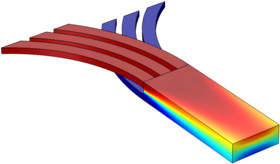
At the macroscopic level, systems usually mix fluids using mechanical actuators or turbulent 3D flow. At the microscale level, however, neither of these approaches is practical or even possible. This model demonstrates the mixing of fluids using laminar-layered flow in a MEMS mixer. This ... En savoir plus

The elastoacoustic effect is a change in the speed of elastic waves that propagate in a structure undergoing static elastic deformations. The effect is used in many ultrasonic techniques for nondestructive testing of prestressed states within structures. This example studies the ... En savoir plus
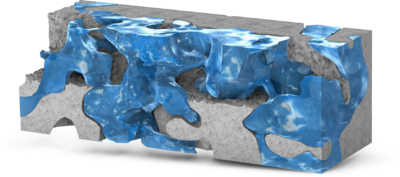
Digital Rock technology utilizes high-resolution imaging techniques, such as SEM and X-ray CT, to characterize the pore structures of rock cores. This approach enables pore-scale modeling of reservoir rocks, offering valuable insights into pore morphology, connectivity, and fluid ... En savoir plus

This tutorial shows how to use the Radiative Beam in Absorbing Media interface (Heat Transfer Module) to model the attenuation of a laser light going through a sample of silica glass, and the heat source generated by the absorption. En savoir plus

Battery electrodes featuring large heterogeneities in terms of particle sizes may sometimes not be adequately described by homogenized models using one single particle size only. As an alternative to adding multiple instances of the Additional Porous Electrode material node, this ... En savoir plus