
La Bibliothèque d'Applications présente des modèles construits avec COMSOL Multiphysics pour la simulation d'une grande variété d'applications, dans les domaines de l'électromagnétisme, de la mécanique des solides, de la mécanique des fluides et de la chimie. Vous pouvez télécharger ces modèles résolus avec leur documentation détaillée, comprenant les instructions de construction pas-à-pas, et vous en servir comme point de départ de votre travail de simulation. Utilisez l'outil de recherche rapide pour trouver les modèles et applications correspondant à votre domaine d'intérêt. Notez que de nombreux exemples présentés ici sont également accessibles via la Bibliothèques d'Applications intégrée au logiciel COMSOL Multiphysics® et disponible à partir du menu Fichier.

This model shows the workflow to define a transfer orbit trajectory with user defined orbit option. The direct solar, albedo, and Earth radiative thermal loads are analyzed during the transfer from low Earth orbit to geostationary orbit. En savoir plus

Fluence rate is a key parameter for ultraviolet (UV) water purifier. It describes the amount of radiation that pathogens absorb and is then directly related to the disinfection level of the purifier. The aim of this example is to demonstrate the fluence rate calculation with the ... En savoir plus
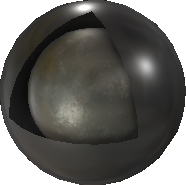
The purpose of this model is to introduce the specular reflection in Surface-to-Surface Radiation using the ray-shooting algorithm. Different parameters are available to the user to yield better accuracy in the results when using the ray-shooting algorithm. The model is a standard ... En savoir plus

Nucleate boiling occurs when a liquid is heated by a source hotter than the saturated fluid temperature but with a heat flux below the critical heat flux. In this regime, high heat flux are possible due to the evaporation of the liquid. This model aims to demonstrate the calculation of ... En savoir plus
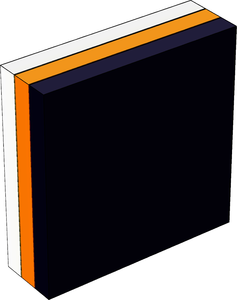
When radiation occurs across a very narrow gap this is often well-approximated as radiation between infinite parallel plates. This model considers three aluminum plates separated by narrow air gaps. The model compares the classical approach, based on the Surface-to-Surface Radiation ... En savoir plus
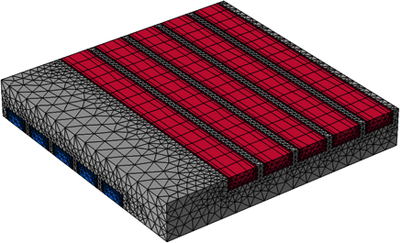
You can use assembly meshing to reduce the number of mesh elements in your model, which is especially useful for conjugate heat transfer simulation in cases where the fluid domains can be handled with swept mesh. These models demonstrate how to use form assembly and discontinuous meshes ... En savoir plus

Inside of a combustion chamber, the gas mix behaves as a non-gray medium. Such media require a lot of data and computational resources to get results across the whole spectrum. The Weighted Sum of Gray Gases Model (WSGG) proposes an approach to model the non-gray gas mix as a sum of ... En savoir plus

A smoke exhaust duct in a building is analyzed. Radiation of a non-gray gas is accounted for with a Radiation in Participating Media interface and the Weighted Sum of Gray Gases Model (WSGG). The smoke exhaust duct consists of 25 mm plaster walls. Building codes require that the walls ... En savoir plus
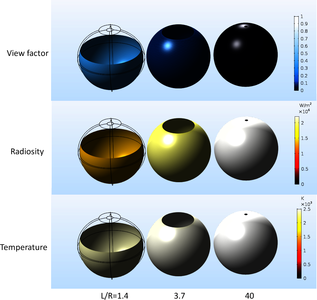
A gray body with a spherical cavity with various opening areas is simulated using the Heat Transfer, Surface-to-Surface Radiation interface. The emissivity for each case is computed and compared with the classical gray body theory. The COMSOL Multiphysics® result agrees very ... En savoir plus

This model aims to demonstrate how a multilayer insulation can affect the temperature distribution of a satellite orbiting around the Earth. It is based on the Spacecraft Thermal Analysis model available in the Application Library. En savoir plus


